


The "Denzel" Principle for strategic success
Updated: Sep 2
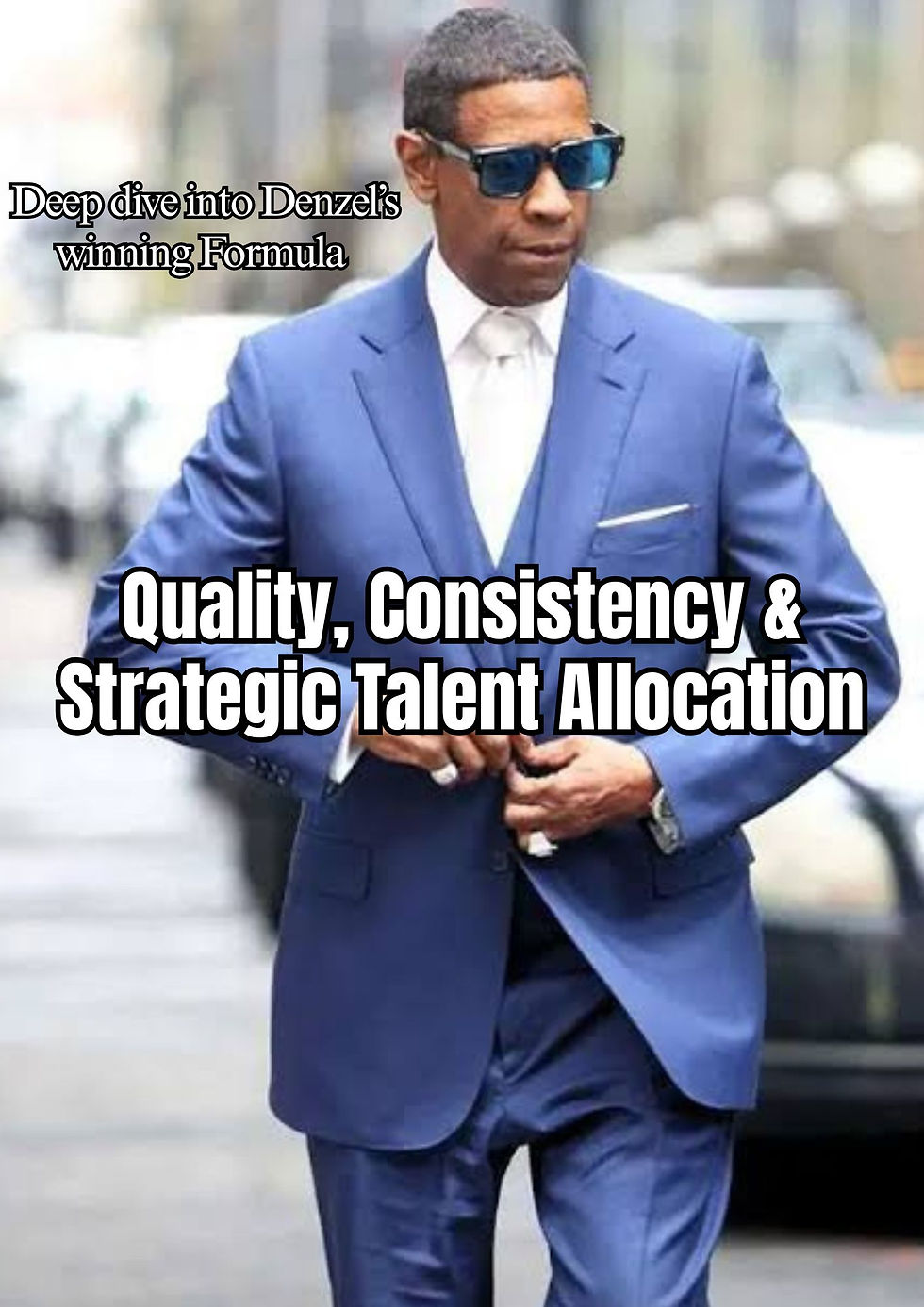
My appreciation for Denzel goes back to his television roots. He didn't just show up on screen; he made himself known, demanded respect, and continuously raised the bar for excellence. We all know the brilliance of his talent, but let's dive into what truly sets him apart—his unshakeable commitment, his steady principles, and his absolute mastery of the profession.
So lets look deeper; What if you had Denzel Washington in your ear providing you with his decades of wisdom and insight when you need it most? His angle may surprise you but its pretty powerful.
Let’s be honest. If you open your phone right now and click on LinkedIn, your feed is likely drowning in a sea of corporate ubiquity. You’ll see executives posting their third "humbled and honored" thought-leadership piece of the week, live-tweeting from a mid-tier regional conference, and practically begging for digital eye contact. They are everywhere. They are accessible. And because they are everywhere, they are effectively invisible.
Now, imagine Denzel Washington doing that. Imagine Denzel posting a selfie with a generic caption like: "Just crushed this table read! #GrindNeverStops #Blessed #ActorLife."
You can’t. It feels wrong. Why? Because Denzel understands the ultimate leverage point of premium strategy: Scarcity Over Ubiquity.
As he famously told his own children when they entered the entertainment industry:
"You want people to say 'I can't wait to see him,' not 'I see him everywhere.'"
For today’s executive, this isn't just great advice for surviving Hollywood; it is a brutal, brilliant blueprint for managing your business partnerships, your strategic decisions, and your professional relationships. If you want to stop chasing deals and start letting the market come to you, you have to learn how to turn the "Denzel Principle" into your unfair competitive advantage.

The Partnership Trap: Stop Dating the Entire Room
Denzel made a career from being strategic and selective in his partnerships and projects. Let’s look at your current partnership strategy. When many companies want to scale, their immediate reflex is to sign cross-promotional deals with anyone who breathes.
They want twenty logos on their pitch deck. They want "strategic alliances" with every vendor from Miami to Seattle. This isn't a strategy; it’s a desperate plea for validation. It’s the business equivalent of swiping right on every single profile on a dating app just to see who replies.
When you make your brand, your product, or your team universally available, you destroy your pricing power. If a client can get a version of your insights, your time, or your distribution through five different "preferred partners," you are no longer a premium destination. You are a commodity. You are the digital storefront equivalent of an all-you-can-eat buffet—plentiful, accessible, and ultimately forgettable.
The Lesson: Become the Velvet Rope

Denzel doesn't star in twelve movies a year. He chooses one definitive project, anchors it with his complete presence, and makes it an event. Apply this back to your operations. Look at your strategic partnerships. Instead of hoarding mediocre alliances, ruthlessly prune them. If you are an executive in tech, media, or consulting, identify the top one or two players whose capabilities completely transform your offering. Commit deeply, execute with terrifying consistency, and make the alliance exclusive.
When the rest of the market realizes they can’t easily buy their way into your ecosystem, a funny psychological shift occurs: they want in even more.
True power in negotiation doesn't come from saying "yes" to a dozen calls; it comes from the quiet confidence of knowing you can say "no" to eleven of them.

Relational Equity:
The Myth of the "Open-Door Policy"
We need to talk about your calendar. If you pride yourself on a literal "open-door policy" where any person, vendor, or casual acquaintance can book fifteen minutes on your schedule to "grab coffee and pick your brain," congratulations: you have successfully outsourced the management of your most valuable asset.
The modern corporate ethos tells us that being accessible makes us collaborative, empathetic leaders. But there is a massive difference between being supportive and being cheap. If your time is an open pasture where anyone can graze, you aren't leading; you're reacting.
The Lesson: The Denzel Metric for Meetings
Think about how you view a leader who is impossibly difficult to get on the phone, but when they finally show up, they completely shift the trajectory of the project. That is the standard you want to set. Take a hard look at your relationship matrix:
The 80/20 Reality: The vast majority of your business breakthrough comes from a tiny, elite cadre of mentors, high-performing internal leaders, and anchor clients.
The Scarcity Pivot: Move your daily interactions from high-frequency/low-value to low-frequency/high-impact.
Stop taking the exploratory alignment calls that could have been an email. When you ration your presence, your voice carries weight. If you are in every meeting room giving your opinion on the office font choice, people start tuning you out like background static. If you only show up when the stakes are highest, the entire room goes quiet the moment you speak.
#FightTheBite! Apply insect #Repellent to bare skin and clothes to keep #Mosquitoes from ruining your perfect summer day. Take a proactive approach – protect yourself and your loved ones from the potential diseases that mosquitoes carry.
Visit miamidade.gov/mosquito to learn more and request a mosquito inspection.
Shared on behalf of Miami-Dade County:

Strategic Focus:
Say No to the "Good" to Say Yes to the "Iconic"

Denzel didn't play it safe, he played it smart. Look at his body of work, his decisions. Its easy to want it all, especially when things are rocking and rolling. You see a new opportunity over there. Its not really your lane but it looks like you can get it done, grow, expand..dominate. That's EGO. It whispers that you’re invincible, blinding you to the fact that spreading yourself too thin is a fast track to mediocrity. Real growth requires the discipline to say "no" to the good opportunities so you can say "yes" to the truly great ones.
Every executive suffers from the same recurring nightmare: Shiny Object Syndrome. A new market segment opens up, a competitor launches a flashy sub-brand, or a vendor pitches a wild new distribution play. The immediate instinct is to deploy resources to cover the flank. "We need to be in that space!" the boardroom screams.
Ubiquity in strategy leads to catastrophic operational dilution. If your team is trying to win three different market wars simultaneously, they are spreading their energy so thin that an aggressive, hyper-focused competitor will slice right through them.
The Lesson: Protect the Core Franchise
Denzel Washington has spent decades turning down massive blockbusters because they didn't align with his specific artistic roadmap. He didn't chase the trend of the month; he protected the integrity of his core performance style.
Bring this back to your business strategy. What is your definitive market win? What is the one thing your organization does so exceptionally well that competitors look at it and despair?
If you run a media network, don't try to build ten generic channels; build the definitive premium space for your target demographic.
If you build software, don't add twenty features to satisfy a vocal minority; perfect the core tool that solves the client's biggest headache.
True strategic scarcity means having the discipline to look at a highly profitable, perfectly reasonable opportunity and saying: "That’s a good business play. But it’s not our play."
Learn To Recycle Right
Reduce contamination by recycling ONLY the following clean and dry items: Paper • Cans • Cartons • Cardboard • Bottles (plastic & glass) • Plastic Tubs & Jugs (such as yogurt and butter tubs). Call 311 or visit miamidade.gov/recycling for a full list of accepted recyclables.
Shared on behalf of Miami-Dade County:

The Executive Challenge
Don’t just chase the thrill of running; respect the boundaries of the track that built you. As Denzel Washington famously reminded us, ease is a greater threat to progress than hardship. True success demands the ultimate discipline: guarding your lane fiercely so that your focus stays absolute and your impact remains undeniable. The next time you feel the itch to jump on a trend, sign an easy partnership, or fill a blank afternoon with aimless networking, pause and ask yourself the foundational question: Are you building an empire of noise, or are you constructing a monument of value?
Step away from the desire to be seen everywhere. Shrink your circle, elevate your baseline requirements for partnership, and make your presence an absolute premium. Let the rest of the market run themselves ragged trying to occupy every corner of the room. You just need to own the stage. Be rare. Be impactful. Be Scarcity.




Comments